Increase Monthly Cash Flow
Retirement Strategy
How Can Your Home Equity Produce More Retirement Income?

- Should I rent or buy? OR
- Which will leave me with the most monthly income and preserve my financial security?
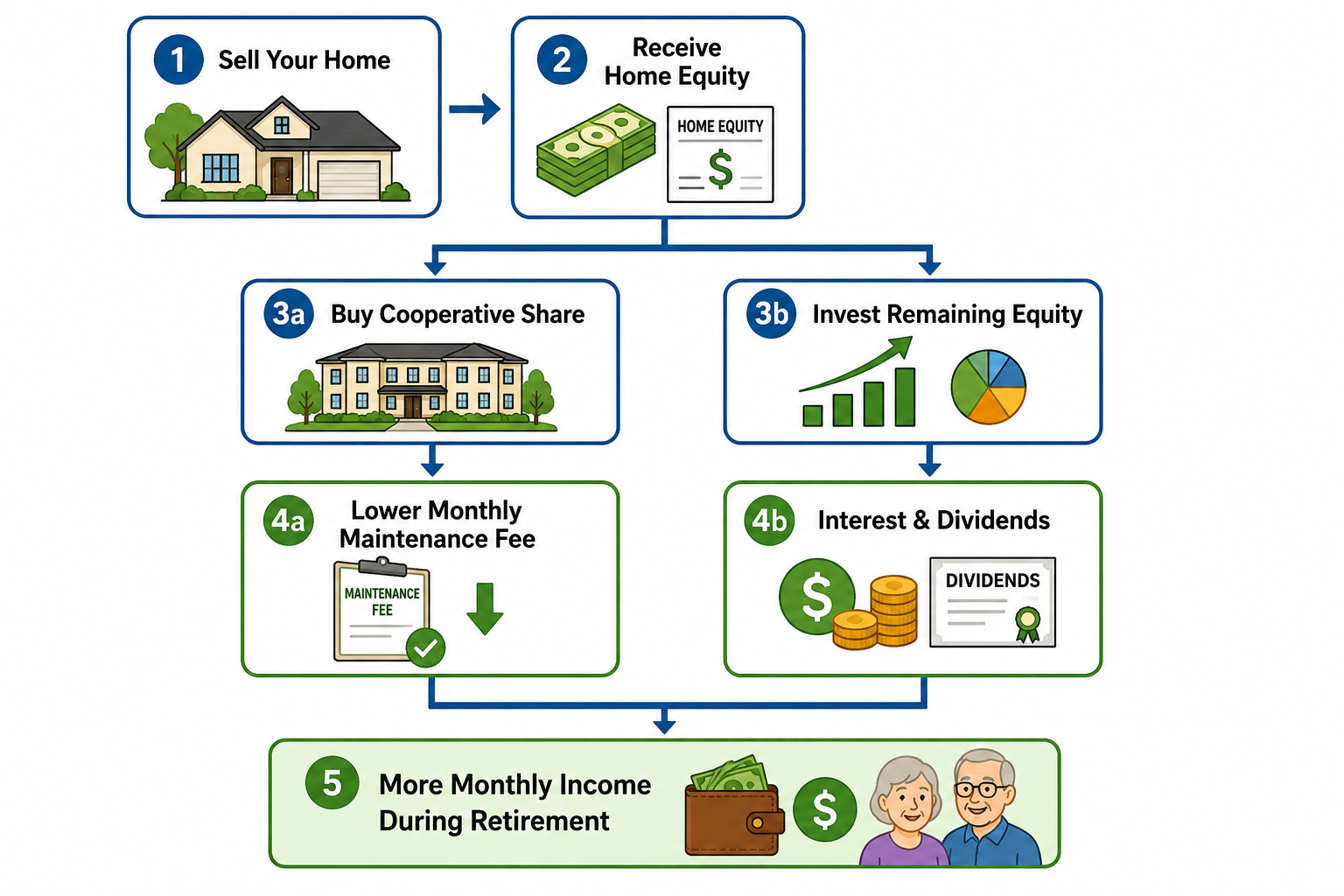
Many retirees selling a home have significant home equity. They can use a portion of that equity to purchase a cooperative share while investing the remainder. The investment income, combined with lower monthly housing costs, often results in more disposable income each month than renting.
If you're selling a home, the question isn't where you'll spend your money—it's where your equity will work hardest for you.
The Hidden Advantage
Now imagine someone sells their home and has substantial equity. Instead of paying rent forever, they purchase a cooperative share for $135,000 and invest the remaining proceeds from the home sale.
That investment can generate ongoing interest and dividend income while the resident also enjoys housing costs that are hundreds of dollars lower each month than renting.
Improved Cash Flow
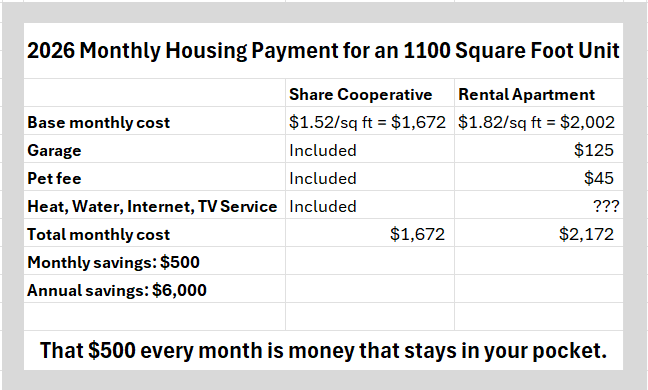
The result is two sources of improved cash flow:
- investment income
- lower monthly housing expenses
Both work together to improve retirement finances.
Unlike Rent, a Share Is an Asset
Rent payments are an expense. A cooperative share is an asset that can later be sold. While resale values can rise or fall depending on market conditions, the purchase isn't simply money that disappears each month like rent. Many prospective residents overlook this distinction because they mentally compare a cooperative to an apartment instead of comparing it to selling one home and buying another.
Think 10 Years Ahead
Suppose the cooperative share saves approximately $500 each month.
After ten years:
- approximately $60,000 less spent on housing costs
- garage fees avoided
- pet fees avoided
- investment earnings continue on the remaining home-sale proceeds.
That represents a significant improvement in retirement cash flow.
A Cooperative Share is a Retirement Strategy, Not Just Housing
A cooperative isn't simply another place to live. It is a financial strategy that allows retirees to:
- convert home equity into investment assets
- lower ongoing housing expenses
- eliminate many additional monthly fees
- preserve capital by owning a transferable share instead of paying rent indefinitely
- enjoy maintenance-free living
GOAL
The GOAL is not simply lower housing costs. The GOAL is to create more monthly income throughout retirement.
Don't Compare a Cooperative Share to an Apartment
- The arguments are often — "Why would I buy when I could just rent?"— "An Apartment = No purchase required."
- That's the wrong comparison.
- The right comparison is: "I'm selling one home and deciding what to do with the equity."
- You are making an investment decision, not just a housing decision.
- The cooperative is a housing investment rather than a housing expense.
For example:
Renting
- Housing is an expense.
- Every monthly payment is gone forever.
- Future rent increases are outside your control.
Cooperative Share
- Housing is partially an investment.
- You own a share in the corporation.
- Your monthly maintenance fee covers operating costs rather than a landlord's profit.
- When you move, you sell your share and recover its market value, subject to market conditions.
The goal in retirement isn't to minimize the amount of money you spend today.
It's to maximize the amount of income you'll have every month for the rest of your life!